

Skip to content
DebuggersEdge

Mobile App Development

Mobile apps for iOS and Android, shipped to both stores.

We take an app from the first sketch through store approval and the releases after it: one team covering design, engineering, backend and the submission paperwork nobody enjoys.

Mobile App Development
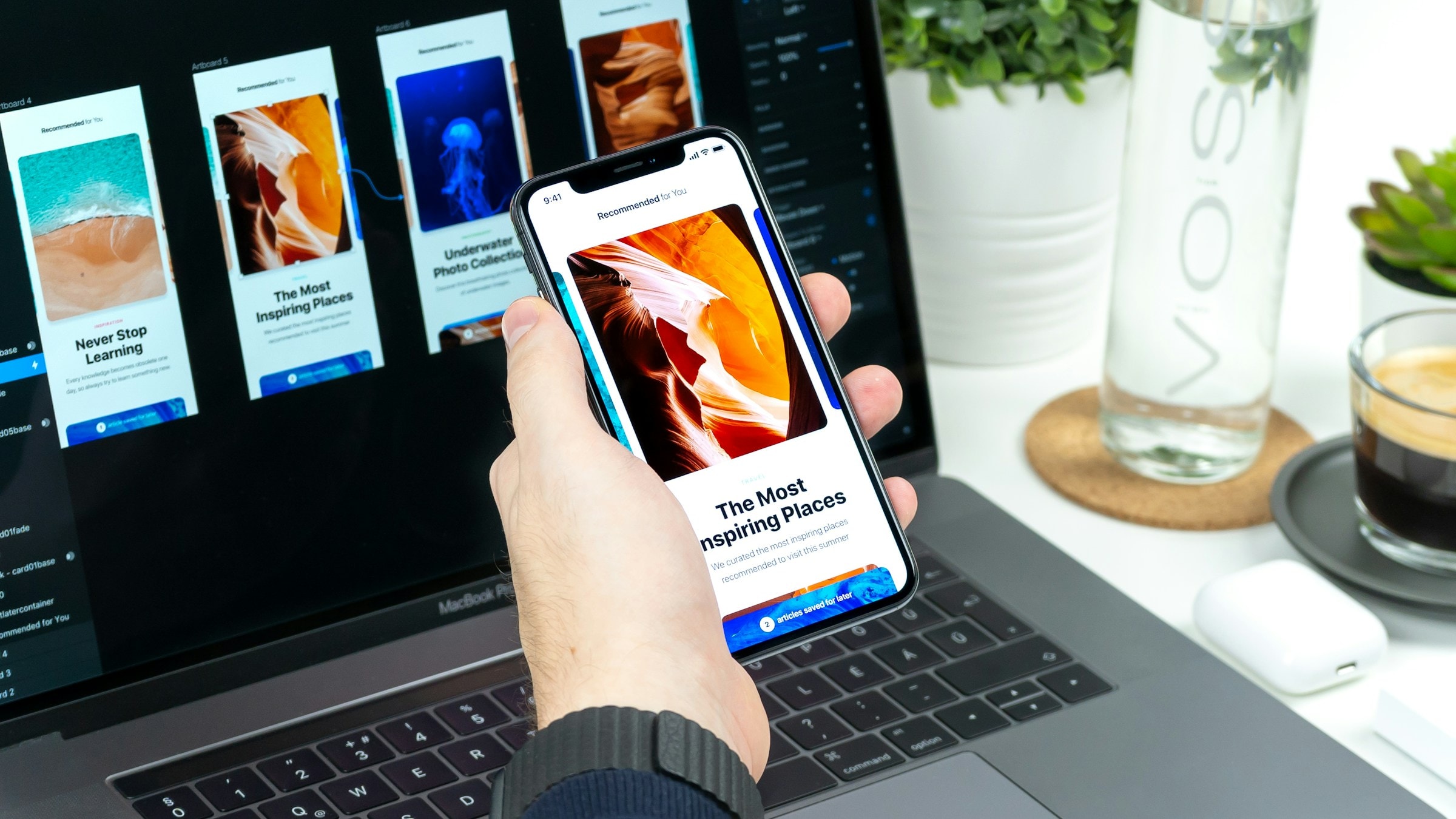
A hand holding a phone running an app, in front of a laptop showing its other screens
Mobile App Development

The store is where mobile projects get stuck.

Building screens is rarely what delays a mobile launch. Signing, review rejections, flaky connectivity, push delivery and the long tail of device sizes are, and they tend to show up in the final fortnight.

We plan for them from the start. The release pipeline is working in the first sprint, offline behaviour is a design decision rather than a bug, and review guidelines are checked before the features they affect are built.

Included

  • Cross-platform builds in React Native or Flutter, native Swift/Kotlin where it matters
  • Offline-first data sync, push notifications and deep linking
  • App Store and Play Store submission, review handling and staged rollouts
  • Automated CI/CD with signed builds and over-the-air updates

What you end up with

A shipped app in both stores with crash reporting, analytics and a release pipeline your team can run without us.

The difference

An app that demos vs. an app that ships

The difference is mostly invisible in a screen recording and obvious in production.

Demo-grade app

  • Works on the developer's phone and on good wifi
  • Builds made by hand from one person's laptop
  • Crashes discovered through one-star reviews
  • Every fix waits days for store review
  • A blank screen whenever the network drops

Production app

  • Tested across device sizes, OS versions and poor connections
  • Signed builds produced by CI on every merge
  • Crash reporting and analytics wired in before launch
  • Over-the-air updates for fixes that cannot wait
  • Local-first data that syncs when the signal returns

What we build

The kinds of apps we build

Platform choice follows the product. We will recommend native where it earns its cost and cross-platform everywhere else.

  1. Cross-platform apps

    One React Native or Flutter codebase for iOS and Android, the right default for most products, at roughly the cost of one platform.

  2. Native iOS and Android

    Swift and Kotlin for apps that lean on platform capabilities: heavy camera or audio work, widgets, wearables, background processing.

  3. Offline-first field apps

    Apps for crews, drivers and technicians who work without signal: local databases, conflict-aware sync and resilient uploads.

  4. Companion apps for web products

    The mobile side of an existing platform, sharing its API, auth and design system rather than reinventing them.

Process

How the work runs, phase by phase.

Each phase ends with something you can see, use or sign off.

  1. Scope and platform decision

    User flows, device capabilities and store requirements mapped, ending in a clear cross-platform or native recommendation.

  2. Design and prototype

    A clickable prototype on a real device, following platform conventions so the app feels at home on both systems.

  3. Build in sprints

    Two-week sprints, each ending with a build installed on your phone through TestFlight and Play internal testing.

  4. Hardening and beta

    Device matrix testing, performance profiling, accessibility and a closed beta with real users before the store ever sees it.

  5. Submission and release

    Store listings, privacy declarations and review handling, then a staged rollout with monitoring on crash-free sessions.

Stack

The tools we reach for.

Defaults, not dogma. If you already run something else, we work within it.

Cross-platform
  • React Native
  • Expo
  • Flutter
Native
  • Swift
  • SwiftUI
  • Kotlin
  • Jetpack Compose
Data & sync
  • SQLite
  • WatermelonDB
  • Realm
  • GraphQL / REST
Services
  • Firebase
  • Push notifications
  • In-app purchases
  • Deep links
Release
  • Fastlane
  • EAS
  • TestFlight
  • Sentry

Timelines

How long it usually takes.

Typical ranges for well-scoped work. Discovery comes first and produces a fixed quote and a date.

Focused MVP

8–10 weeks

One core workflow on both platforms, through store approval.

Full product

10–16 weeks

Accounts, payments, notifications, offline support and an admin surface.

Companion app

6–10 weeks

Mobile client for an existing web product and API.

Case studies

Where we have done this before.

A lorry on an open road under a clear sky

Logistics

An offline-first mobile app for crews with no signal

Technicians filled in paper job sheets that were re-typed into a spreadsheet two days later, so dispatch never knew what had actually been completed.

Job data available same-day instead of after 48h

Industries

Sectors where this comes up most.

A delivery truck on a remote mountain road

Logistics & Field Service

Driver and technician apps, dispatch consoles and tracking that work where the signal does not.

Hands typing on a laptop beside a stethoscope

Healthcare

Telemedicine, patient portals and clinical tools built around real workflows and a privacy-first architecture.

A customer and a shopkeeper at a point-of-sale tablet

Retail & E-Commerce

Storefronts, apps and back-office tooling that load fast, convert and stay in sync with inventory.

FAQ

Mobile App Development: common questions.

Should we build native or cross-platform?

Cross-platform is the right call for most business apps: one codebase, both stores, and performance users cannot tell apart from native. We recommend native when the app depends heavily on platform-specific capabilities, and we will explain the trade-off in discovery rather than defaulting to either.

Do you handle App Store and Play Store submission?

Yes. Listings, screenshots, privacy declarations, review responses and staged rollouts are part of the engagement. The developer accounts are yours. We work in them as team members.

Can the app work offline?

Yes, and for field or travel use cases it should. We design the data model for local-first storage and conflict-aware sync from the start, because retrofitting it is far more expensive.

Do we need a backend as well?

Most apps do. We build it alongside the app or integrate with the one you have, so the mobile team is never waiting on an API from another vendor.

What happens after launch?

OS updates, new device sizes and store policy changes keep arriving. You can keep us on a support retainer or take over with the documented pipeline. Builds and releases do not depend on anyone's laptop.

Next step

Have something that needs building?

Tell us the problem in a few sentences. We will reply within one business day with an honest read on scope, cost and whether we are the right team for it.